

Has a $40 dress been to more countries than you traveled to last year?
If we take a step back and define what “mass market” really means in fashion, it is not simply affordable clothing, but a highly industrialized model built to produce standardized garments in large volumes, using inexpensive materials and efficient, often automated processes in order to serve millions of customers at a price point that feels accessible.
To achieve that accessibility, production is intentionally fragmented across geographies, with fibers grown in one region, spun into yarn in another, woven into fabric somewhere else, dyed and finished in a specialized hub, and finally assembled where labor and capacity are most competitive, which means that by the time a simple dress reaches the shelf it may have traveled more than 15,000 kilometers before the customer even touches it.
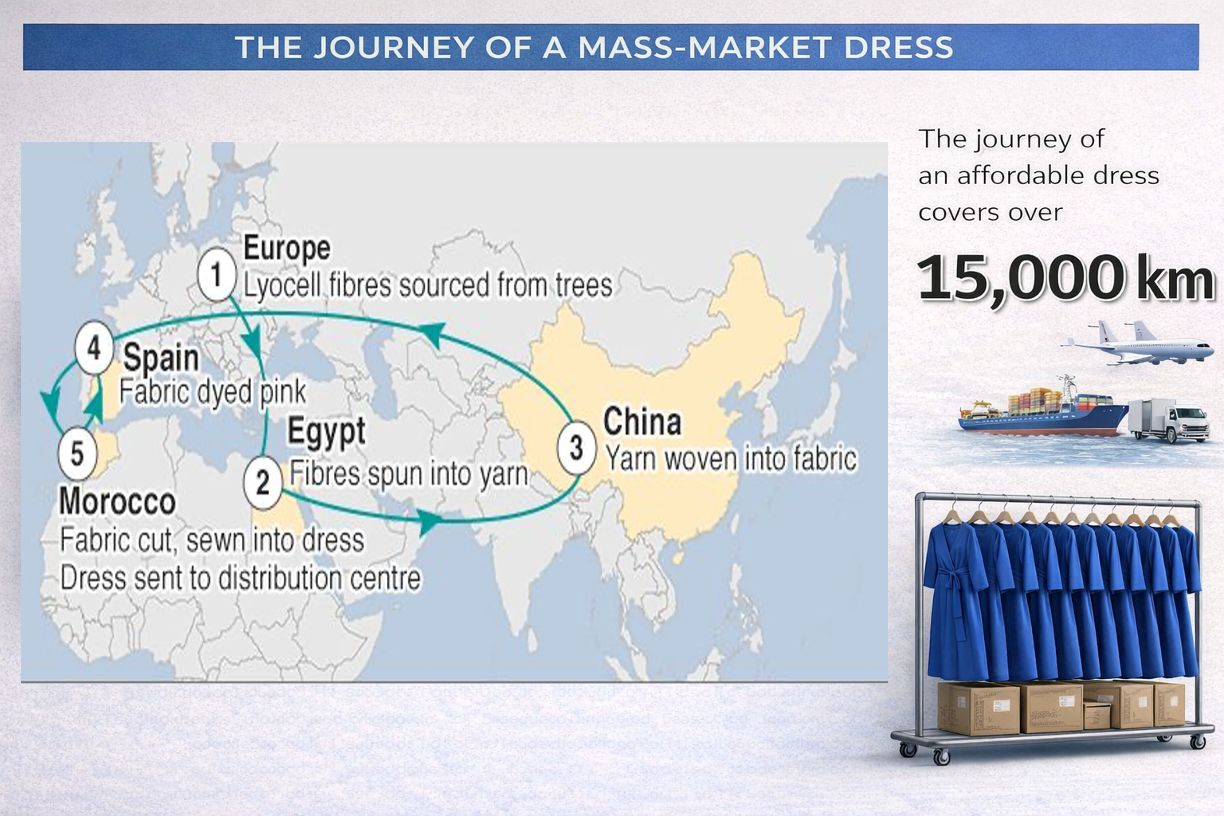
This global dispersion is a cost strategy, because each stage is located where it can be executed most efficiently, whether through lower labor cost, established infrastructure, trade advantages, or energy pricing. But while this structure reduces unit cost at scale, it simultaneously increases operational complexity, extending lead times and exposing the business to currency movements, tariffs, logistics disruptions, regulatory shifts, and quality variability across multiple jurisdictions.
What appears to be a straightforward ~$40 dress is therefore the output of a carefully orchestrated global network that must align sourcing, production planning, freight, customs compliance, and working capital management under tight margin pressure.
The paradox is that the lower the visible price on the rack, the more sophisticated and globally interconnected the supply chain behind it is likely to be, because saving cents at scale requires precision coordination across borders.
What appears to be a straightforward ~$40 dress is therefore the output of a carefully orchestrated global network that must align sourcing, production planning, freight, customs compliance, and working capital management under tight margin pressure.
The paradox is that the lower the visible price on the rack, the more sophisticated and globally interconnected the supply chain behind it is likely to be, because saving cents at scale requires precision coordination across borders.